Monday, February 13, 2012

Welcome to Afghanistan


OK, first off today, folks, it's "bated breath," not "baited breath" ... As in phrases such as "I await your response with bated breath."  It's a shortened form of "abate," which means to lessen or lower.  Like so many other words, it's first use can be traced to Shakespeare.  Normally I'm not that much of a stickler for these things.  It's just that every time I read "baited breath" the picture I get is "I've just eaten a bunch of nightcrawlers, so my breath may not be the freshest."

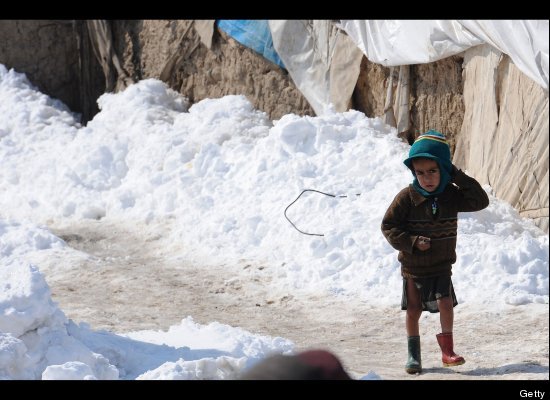
It's the coldest winter here in 15 year.  Most nights get down somewhere between -10 and -20 deg C, and it only warms up to snow.  We've got easily a foot in the last 36 hours and it's still coming down hard.The bad news is that at least 24 children have frozen to death in the refuge camps around Kabul.  Deforestation is a big environmental challenge here, and wood for fires is a rare commodity, made all the rarer by a spike in demand due to the cold.   I read one heart-breaking story about a baby who died, and the mother related that they have lost eight of their nine children to disease and cold.  One ten-year old girl left.  Welcome to Afghanistan.

Not quite dressed for the weather

However, this record snowfall means no drought this year. The snowpack in the mountains should ensure a good spring and early summer run-off.

Kabul used t be a green city, famous for its orchards, just a few decades ago.  I gather the main culprit was the Soviets who cut down the trees to deny insurgents cover (shades of Agent Orange).  There was a tree-planting aid coming in by I'm told that one of the higher-ups was selling the trees and they never got planted.

In a similar story, I lugged two duffle bags full of soccer stuff and girls' toiletries for the local orphanage here, but I'm told we can't give stuff to them any more because the lady running the place would take all the stuff back from the girls and sell it.  Even the blankets they needed to stay warm at night.  Welcome to Afghanistan.

Well, I'm given to understand that the situation will shortly be rectified and they're getting a new director in, so n the meantime I wait with bated breath.

Wednesday, February 8, 2012

How the Baby Boomers Ruined Everything for Gen X (But I'm Not Bitter)


As a young up-and-comer in the federal government in about '96, I was invited to a talk for generally more senior managers by Linda Duxbury.  Duxbury is an academic from Carleton who has made quite a name for herself in academic circles speaking about demographic changes in the workforce and such.  She's got the whole "Men are from Mars, Women are from Venus" thing happening and is quite an engaging speaker, if not particularly edifying.

In this particular talk, she would say that the pre-Baby Boomer generation--I forget what pet name she had for them--were set in their ways, and wanted everything to stay the same, because in their generation you were a company man.  The Baby Boomers--like Duxbury herself--were fun, inquisitive, interesting.

Then she moved on to Gen X--those she defined as born after 1964.  We  really fare too well in her analysis. I believe "bitter" was the adjective used.  She asked at one point "So what does Generation X want?"  It was supposed to be a rhetorical question, and she was just about to launch into her prepared answer when I piped up, "Not to be called bitter?"  I was one of only two or three Gen Xers in the room, the rest being Baby Boomers.  Duxbury jumped on the opportunity to portray my "outburst" as evidence that the Gen Xers are, indeed, bitter.  She had the perfect little argument really.  Any evidence against her argument was evidence for her argument.  It's like:
"You're in denial"
"No, I'm not"
"See!"

I still don't readily apply the word "bitter" to myself, but I would go so far as to say "rueful."  It's not that the Baby Boomers are bad, it's just that, as the demographic majority in a democracy, they’ve managed to fashion society to their liking through the decades. It's a tyranny of the majority, plain and simple.  You can't get mad at a mathematical reality.

Think of it. When the Boomers were kids, they had the 50s, which was all about family values.  In the early 60s you had bubblegum pop which ripened into the sex, drugs and rock'n'roll of the late 60s. The Boomers were young adults and in the exploratory stage they had an explosion of art the likes of which we have not seen since, they had a commitment to ideologies of peace and love.  And they had an insatiable curiosity that put a man on the moon (allegedly!).  The 80s turned into the "Me Decade" as Boomers, in their 30s now, put away childish things and focused on accumulation.  

With the advent of the third millennium, mortality hit the Boomers like a meringue pie in the face.  Change was now to be feared--thus this new wave of social conservatism.  Life was dangerous--thus the advent of mandatory safety and the nanny state.  And death was the new enemy--thus the explosion of life-extension and youth-preservation medicine.  The War on Cancer is, I think, a proxy War on Aging and Death.  (Especially if you research carcinogenesis and its similarities to the aging process and cell senescence.)

I was reminded of this when Newt Gingrich floated (no pun intended) the idea of a moon base, and was unanimously laughed off the stage.  No one laughed when Kennedy wanted to put a man on the moon.  Back then science was revered and the young, ideological Boomers were ready for any challenge.  But to present such an idea "in today's economy" was ludicrous, said the pundits. The cost of a moon base is estimated according to the Centre for Strategic and International Studies in 2007 would be about $35 billion, and about 7.5 gigabucks a year to keep it going.

But medical research funding in the US, according to this study is estimated at about $90 billion in 2008 (4.5% of total health care costs) in the US.  A good chunk of this was in research diseases that are more common in the last trimester of life (cancer, heart disease, Alzheimers). Add to that (let's be perfectly bloodless about this) the fact that life extension applies primarily to retired people who are no longer working and often drawing upon as opposed to contributing to the social safety nets, and your economic cost increases.  And add to that the fact that Old Age Security / Social Security are now openly admitted as being essentially pyramid schemes that will see the Boomers through to their dotage and then collapse, and the economics of life extension spending takes another hit.

So it's nothing to do with "economic reality" and everything to with "biological reality."  The naïve promise of the stars has been replaced by the biological imperative to stay alive, and is the new priority because of course, of the Boomer's majority demographic.

So no, I'm not bitter.  I just think we need to take all the Boomers, mulch them up, and shoot them into the atmosphere to stop global warming.

Sunday, February 5, 2012

The Continuing Adventures of Thermodynamics and Exergy


Earlier, some time ago, I was talking about thermodynamics and exergy. When talking about energy, we tend to lump al forms of them together as if they were the same--oil, nuclear, wind, solar, electric and what have you.  But energy comes in many different forms.  Recall the First Law of Thermodynamics says that energy can be neither created nor destroyed. It merely changes form.

Exergy is a measure of the quality of the different types of energy, the amount of work available in the energy to do something useful for us.  It's an analysis of energy using the Second Law of Thermodynamics--entropy. 

Let's take the example of electric heat--driving a current through a resistor to produce heat.  From a First Law perspective, this is very efficient.  Every watt of energy pushed through turns to heat, which is exactly what we wanted--virtually 100% efficient.  But from a Second Law perspective, from a measure of energy quality, you're taking a form of energy (electricity) capable of heating a tungsten filament in a light bulb to 3000°C and you're using it to heat a room by five degrees. It's like, "Pass me that grenade, I think I see a fly on the wall."

To turn oil into electricity, the crude must first be accessed by drilling a whole into the ground, then pumped out, treated, pumped again, refined, pumped again, burned in a burner which heats water to produce steam to drive turbines which rotate a generator coil to produce electricity. A tremendous amount of heat is generated by the friction of the drill in the rock, as well as the heat given off by all the pump motors and through the refining process. Coal plants have vast cooling towers where the steam is cooled back to water, to be pumped once again through the burner.  All that heat wasted just so you can take the final product--electricity--to heat your room.  If some of that "waste" heat were captured, you wouldn't need that electricity to start with.

Cooling Towers at Ferrybridge Power, West Yorkshire


This isn't news to power engineers.  That's why they developed co-generation plants at several pulp mills in BC.  They use their waste wood in a traditional turbine generator to make electricity.  A typically set up is about 50% efficient, with the other 50% lost to "waste heat."  IN a cogeneration plant, this heat is captured to provide heat for the mill.  So the mill is creating surplus electricity to sell to the grid, and creating heat for the mill.

Or there's urban geothermal heating, where water is pumped deep into the earth, heated up, and then pumped as hot water to a bunch of surrounding buildings. Here you are matching a low-quality energy (geothermal heat) to a low-quality use (indoor heating).

Or there's architectural methods to conserve heat, or, more commonly, to conserve cool.  Putting trees on the roof, using "light shelves" to channel natural sunlight to interior offices, making the building itself a solar cell.  I don't know much about that end, but it seems to me, with these new incredibly efficient buildings, that the architects are charting the path here.

There are, of course, challenges.  We already have a ready infrastructure to transmit electricity, but to pump hot water around a high density area requires a whole new insulated piping system.  And collecting waste heat from industrial operations is an intensive undertaking.  There's fugitive heat coming from every pump, every reactor, every piston.

And, more vexing, oil and coal are just so darned cheap and packed with energy. To use a mining analogy, who wants to go around picking up gold flecks when there's big nuggets everywhere.  Put another way, we are not being efficient, because we don't have to be efficient. 

But, as we all know, both population and per capita consumption are rising exponentially (actually, logarithmically, to be perfect correct), and the amount of available coal, oil and gas is limited. 

(You often here folks say we have enough coal, or bitumen or shale to last hundreds of years, but that again is more like a First Law analysis--i.e. just an accounting of the total volume of hydrocarbon out there.  However, from a Second Law analysis, a lot of that hydrocarbon isn't available, since it takes more than a barrel's worth of oil in energy to extract and refine a barrel of it.  This is why some people were floating the idea of a nuclear power plant in the Alberta oil sands--so they wouldn't be burning oil to get oil.)

Anyway, energy scarcity--or peak oil, if you will--seems to  me like a mathematical inevitability, barring some kind of apocalypse or other.  The society that has already examined ways to use energy more efficiently is going to be further ahead I the long haul.

Thursday, February 2, 2012

Pictures of Kabul


A little late with this blog posting. I blame it on my roomie moving out, giving me some blessed solitude--something very rare on a highly dense military base. My roommate and friend Master Sergeant Ronnie R is headed back to Germany to see his wife and little ones. I hope I do as well with my next roomie. I immediately proceeded to abuse my newfound privacy by staying up late surfing the web, playing video games and watching movies. This is probably one of the reasons that it's wise to double up the rooms. It prevents a sort of natural withdrawal that is natural in such a crowded place. It won't be a problem for long though; any day now I'll get a new roomie. Hope he's as good as the last one.

It's snowing very heavily right now. We're in this nasty cycle of snow/thaw/freeze that leaves the entire place like an ice rink and plays hell with the engineering, cracking the concrete and loading the roofs and structures with ice. It got down to almost -20°C here a few days ago. Who knew it got that cold here? Just another reason why Kabul is such an international tourist mecca I guess. 


Speaking of Mecca, we discovered that toilets used by the Afghan locals have to be oriented so that they don't face Mecca. When this was announced, one of the sharper engineers offered "so which way do they orient the toilets in Mecca?"

In this next four month stint in Kabul, I'm determined to get out and about a little more to see Kabul. The first few months, I stayed close to home, as I felt I lacked the situational awareness to go wandering about Kabul. Also, there's military mindset here (not surprising for a military base, I suppose), that treats the city proper as a battle space. But the reality is that there are thousands of European and North American civilians living in Kabul, usually associated with some type of non-governmental association or another.

That said, you always have to keep your wits and eyes sharp when you're out and about. The biggest danger isn't insurgents, but kidnappers, since the average white guy here is tremendously wealthy compared to your rank-and-file Afghan. So, for example, you don't just hop into anyone's car who claims to be a cab driver. (The taxis here are just regular older-model Toyotas like 90% of the vehicles here.) Some of the guys here have grown beards and wear the scarves and ... so that they blend right in, weather because their job requires them to do so, or they just don't want to stand out. I'm 46 and I still can't grow a beard, plus I'm very white and tall compared to the locals, so I have a gaggle of kids gawking at me wherever I go.

The restaurant was a Lebanese bistro where I was meeting some Afghan friends for lunch. The food was excellent. It was a little uncomfortable having three waiters standing around the table the whole time, sublimely attuned to my most innocuous body language, even to, for example, rearranging the plates on the table so the dish I was reaching for was more conveniently located for me. At times, I felt like a Brit in 19th century India. "Bring me a plate of your finest meats and cheeses. And you-- dance for my amusement."

Afghan people, apart from the occasionally stinkeye, are very friendly. The kids clamor around you where ever you go. When I couldn't find the restaurant and wandered into an alley, these little alley rats offered, in very limited English, to be my bodyguards. To their credit, they somehow took me right where I wanted to go, so I greased their palms with a Yankee dollar and took their picture. 


My Afghan Bodyguards

The Afghan men and children love to have their picture taken. However, it's strictly taboo to take a picture of older girls or women. I've been told I shouldn't even acknowledge them unless I've a reason too.

Oh--and a humorous military logistics anecdote to relate. My friend Bill is the Warehouse guy--you know, keeping the office supplied with pens and paper. So anyway, a couple of days ago, he filled out the form for some stuff including one box of paper clips. I went with him to pick up the stuff, and the Warehouse guy dutifully loads up boxes of paper and a crate of binders, a few packages of pens, etc. And a paperclip. One. I guess the guy took the form pretty literally, where, for paperclips, it requested a Quantity of "1."

"Actually," said Bill, showing immense patience learned oly from years of exposure to military logistics, "I meant one box of paperclips."

"Ohhhhhhhhh."

Or how about this one: one of the Afghan locals working here was turned away from the base recently when he tried to bring a sheep in. There's a lot of locals working here, and the idea was that he was going to slaughter the sheep at lunch time and cook it up. The guard asked him why he didn’t just slaughter it at home or at the butcher, to which the guy replied (with impeccable logic, I might add) that then he would have to carry it here, rather than have lunch walk itself.

As I was clearing up our shared drive the other day, I came across a slideshow put together, I believe, but one of the German engineers that used to work here. There's some fantastic shots here that really portray what it's like here in Kabul. There's some fantastic shots.  Have a look!


Tuesday, January 24, 2012

Rock and Roll Requiem

The Times They Are a'Changing.  We have Rocked Around the Clock, my friends. Let's gather around and listen to that haunting tune by Neil Young, and hold our hats to our hearts as Rock and Roll climbs the Stairway to Heaven.

Hey Hey, My My
Rock 'n' Roll will never die.
Sure sure, you say. We've heard it all before. When the Sex Pistols came out and Rolling Stone magazine declared that "Rock is Sick."  Or when rock became of a parody of itself with the hair bands of the 80s. Or when the 60s rock star actually hit 60.

"I still look better than Keef."

But last year at this time, the Guardian reported that a measly three tracks of the top 100 songs in 2010 fell in the rock genre--and one of them was a thirty-year old Journey ballad called Don't Stop Believin'.  Doesn't look any better for this year.  I checked the Billboard Top 100 for 2011 and counted three rock acts again (and counting Avril Lavigne is a stretch).  So that's two years in a row where rock and roll accounts for a whopping three percent of the top 100 hits.

She's just run her course, from Elvis, to the greasers, to the British Invasion, to Psychedelic, to hard rock, to glam, to punk, to metal, to New Wave, to grunge, to indie.  Fifty years of guitars and sweat; sex, drugs and rock'n'roll. 

That's not to say it will die; that would be a bit melodramatic.  It will join the genres of ages past as part of the Museum of Music.  There's still great jazz bands around, long after the days of the hep cats and jive beats.  The blues, baroque, folk, bluegrass.  All still there.  But they no longer prevail, no longer capture the zeitgeist.

Lay the blame where you please. Simon Cowell and his schlock reality shows, greedy record companies and their accelerating revolving door of the Next Big Thing, technology replacing musicians the way machines replaced factory workers.  But like everything else, like us, Rock and Roll grows old; it withers under the weight of its years.  The way rock, with its electric amplifiers swept aside the clarinets and trombones, so the computers are sweeping aside the old tube amplifiers. 

"But these techno guys can't even play an instrument?"  No.  Neither could those early rockers.  How do you think those jazz guys felt--woodshedding for years to get their chops down--to see these pimply teenagers power-chording their way to riches.  Malcolm Young (rhythm guitar, AC/DC) has probably got a 50' yacht thanks to G, D and C chords.  (No offence, Malc--if I were in a band with Angus, I'd stick to chords too.)

It's passing is bittersweet. I'll rock to the end, with my friends, in garages, studios and questionable joints everywhere.  And I'll always love it, but I will not over-mourn its passing.  Rock and roll melded with other kinds of music and made beautiful babies.  A little bit of Alice Cooper in Lady Gaga. A little Black Sabbath in that trance beat. 

I'll miss the poetry.  I mean, I like the party music, the LMFAO and the Lady Gaga, but it lacks the poetry of John Lennon, Pink Floyd, Bon Scott.  The current crop of pop music lacks that honesty and self-reflection. But this too shall pass, as the pendulum swings.  Early rock-n-roll wasn't all that stellar in the lyric department, as I recall ("I found my thrills...", "She loves you, yeah, yeah, yeah...")   And I'll miss rock-n-roll ugly.  It's all polish and pretty and perfume now.


Then (Shane McGowan, Motorhead)


Now (Adam Levine, Rihanna) 

On the other hand, I like the way that control has been wrested from the record companies.  Digital sharing of music has shaken up the system, decentralized control from the conglomerates and created an environment of chaos where, I think, creativity will thrive and new and unexpected things will arrive.

Sure the labels are predicting the end of music.  But music will always be there, and it will always be transcendent and divine.

Incidentally, right now I'm listening to Otep, Smash the Control Machine, and Five Finger Death Punch, Generation Dead, and Muse, Exogenesis.  All good, relatively new stuff, IMHO.

Anyway, you may not agree with me, but I'm right and you're wrong.  So there. 

So let's raise a toast, shall we?  A toast to St John of Liverpool, and Jim Morrison and Janis and Jimi and George and Kurt and Keith. To being 14, drunk and giddy, walking into your first arena rock concert.  To making out to Led Zeppelin III.  To pulling Wish You Were Here, brand-new, out of it's record sleeve, careful to handle it only by the edge.  To listening to Fool to Cry over and over again after your first heartbreak.  To the sweaty mosh pit at the Commodore when Pearl Jam played there before they made it.  To the soundtrack of my wild and beautiful youth.  You Rock, rock'n'roll.

Saturday, January 21, 2012

How I Spent My Summer Vacation, 1989

Ain't got no picture postcards, ain't got no souvenirs,
My baby, she don't know me when I'm thinking 'bout those years.
-- Tragically Hip, New Orleans is Sinking

After second year chemical engineering at UBC, I couldn't find an industry-related job.  Times were tough for engineers in 1990; doubly tough when recent grads a little older than us were boasting of when companies used to vie for their affections with promises of new cars and ten thousand dollar signing bonuses.  Also, I was and continue to be absolutely abysmal in job interviews.  Seriously, it's like I'm hovering over top of myself, slapping my forehead and thinking "Did you really just say that, you moron?"

What's more I was not completely convinced I'd passed. In first semester I'd gotten 23% and 25% in my calculus courses, although it was aces all the way in Drinking 101. I'd completed the test for the esteemed 40-Beer patch in an astounding 6 hours and 23 minutes.   Joining a frat didn’t help academic matters any.  You needed a 55 average to stay in the game.

So, jobless, I headed back to Winnipeg, where I'd lived and bartended until the year before.  My buddy Jamie had a pad on Manitoba and Salter in the North End (or as the media refer to it, "Winnipeg's troubled North End").  Jamie was a big feller and he bounced at a couple of the more questionable joints in town.  The house where he lived was pretty much a tear-down and you never really knew all the faces who were crashing there.

It was 1989. Nirvana was trying to make it in the Seattle bar scene, and the internet was still just text-driven bulletin boards populated by nerds. The 90s were out there,  just waiting to happen.

I went down to the Unemployment Office and perused the little indexed cards looking for something I was remotely qualified to do.  There was nothing for engineering, but there was a job requiring a guitar player and another looking for a bartender.  Bingo!

My prospective employer, David M, ran a pawn shop on Main Street in Winnipeg, a street comprised primarily of lo-rent hotels, bars, pawn shops and discount stores.  Like any pawnshop, guitars are a good chunk of the business (what does this tell you about guitar players?), along with jewelry, small appliances and stereo equipment.  David needed someone to keep the axes tuned and demonstrate them to prospective buyers.  It was close to where I lived, and I could handle keeping a bunch of guitars tuned.  And the job interview was a lot less stressful than Proctor and Gamble's.  I took the job.

This ain't it, but it looked a lot like this.

David and Karen were your stereotypical old Jewish couple who would argue back and forth in Yiddish all day, regardless of who was in the store.  I liked them a lot.  And they liked me.  I was honest and showed up to work sober (if occasionally hung over).  The clientele was primarily natives, who, along with Eastern European immigrants, comprised the dominant ethnicity of the North End.

One time, some guy pulled up in a Caddy looking for a radio for his garage  "Just something cheap" he kept saying.  Whatever David put in front of him he'd balk at the price, and said if he wanted to pay that he'd go to "regular" store.  Well David didn’t like that and he took the radio and smashed it on the counter and said "There!  That's what I'd do rather than sell it to you.  Now get out of my store." 

Nights and weekends, I worked the Manor Hotel just down the street.  This may have the dubious distinction of being the biggest dive in the North End.  It was mostly haunted by old-man Ukrainians and Poles who lived upstairs drawing welfare.  The beer was literally so bad that I couldn't even give it away to my friends, who were not exactly folks with the most discriminating of tastes when it came to alcohol.  Not a word of a lie, I had to manually remove cockroach legs from the beer before serving sometimes.  I've no idea how they got into the beer lines.

Every morning at 11:00, four rubbies were lined up at the front door waiting for opening.  They'd file in to the same dark table at the back and order a glass of beer between them.  Their clothes were stuck to their bodies, they'd been wearing them so long, and their breath was the sickly-sweet of decay.  Every one would savour one "virgin" sip from the glass before pulling out the bottle of rubbing alcohol and topping 'er up.  When the liquid in the glass was clear--pure propyl alcohol--it was my cue to kick them out.  They'd spend the rest of the day under the railway bridge.

"Killer" had some kind of degenerative muscular or nerve condition.  He was a young fellow, a couple of years older than me, though shriveled and bent by his condition. He'd piss himself and not even know it, so he didn't always smell the best.  Plus he was a homeless alcoholic.  He'd come in a shoot pool a while when his check came in, and boast about how he could kick anyone's ass on the table.  Friendly guy.  I came out at closing time one time and he was lying the street.  I guess a bunch of thugs had come by and kicked the shit out of him and caved in his face pretty good.  I called the ambulance and saw him off, but never knew what became of him after that.  That's the North End for you right there, though.  I grew up there so I never realized at the time how crazy it was compared to just about anywhere else. 

My evenings were spent with drinking with various bouncers, bikers, gangsters and ne'er-do-wells.  There as Adolph--half German and half Apache. He didn't like to drink because it got in the way of his fighting.  And Steve was tougher than a sack full of frozen hammers, but had a heart of gold.  He got into the heroin though.  And my buddy Jamie was the biggest of them all, though that meant taking on all comers.  He even got a busted beer bottle in the throat that summer, but pulled out of it OK.  I have this surreal memory of us all doing acid one night and heading down to what passed for a carnival in the North End--a few rides and hucksters set up in the Loblaws parking lot--and then partying with the carnies until the wee hours.

It wasn't exactly a sustainable lifestyle, or even a safe one. I was 24 and the choice was stark:  was I going to be an engineer, or run with the bad boys? It all depended on that letter from UBC--pass or fail--and until I got it I lived in a mélange of two worlds and nothing seemed real. I think maybe that's why I went so crazy that summer, why I marched jaw-first into the harshest situations I could uncover--to make it real, to banish the fog of my future by experiencing the now in all its exquisite insanity. Maybe, here in Kabul, I'm still doing that.

I got the letter from UBC late in the summer and was incredibly relieved to find I'd managed to pull the rabbit out of the hat and manage a 57% average, and was soon cloistered once again in the hallowed halls of UBC.  I never went back to Winnipeg after that.  But images from that summer are still seared into my cortex 20-plus years later.